TL;DR: Standalone gift card tracking apps are focused but siloed — they handle cards well and nothing else. All-in-one home and financial platforms treat gift cards as one financial asset among many: warranties, rebates, credits, insurance documents. The right pick depends on whether gift cards are your only tracking problem or just one slice of a larger home management gap. This guide compares eight apps across both categories so you can decide.
Table of Contents
- Why Gift Card Tracking Apps Exist
- What to Look for in a Gift Card Tracker
- Standalone Gift Card Apps Reviewed
- All-in-One Home and Financial Apps with Gift Card Tracking
- Comparison Table
- Which App Is Right for You?
- FAQ
Why Gift Card Tracking Apps Exist
Gift card tracking apps exist because human memory fails at exactly the task gift cards require: remembering small-balance financial instruments with different expiration windows across dozens of retailers. Americans hold roughly $23 billion in unspent gift cards at any given time, and 47% of adults have at least one unused card averaging $187 in balance, according to Bankrate's annual gift card surveys.
That is not a niche problem. It is a mass-market memory failure with a predictable dollar cost, and the app category grew up around it. Separate reporting from CNBC on gift card breakage puts the annual unredeemed total that never gets recovered at roughly $21 billion per year — money that quietly transfers from consumers to corporate balance sheets because nobody built a tracking system for it.
The earliest gift card trackers were simple wallets — you typed in a card number and a balance, and the app kept a list. Over the past decade, the category has split. On one side, standalone gift card apps (wallets, resale marketplaces, balance trackers) focus narrowly on the gift card itself. On the other side, all-in-one home and financial platforms treat gift cards as one line item in a broader picture that includes warranties, rebates, insurance policies, and home documents.
Both approaches can work. Which one fits you depends on whether your goal is "stop losing gift cards" or "stop losing money across my entire home." We covered the underlying scale of the waste in The $23 Billion Problem — this post is about which software actually solves it.
What to Look for in a Gift Card Tracker
A good gift card tracking app does five things: it captures cards with minimal manual entry, stores card numbers and PINs securely, tracks balances over time, monitors expiration dates, and alerts you before cards expire. Anything less is just a digital list. Anything more — like cross-asset tracking or email scanning — is where the category starts pulling apart.
Here is the feature checklist that actually matters in 2026:
Must-have features:
- Email scanning or auto-capture. Manual data entry is the reason tracking systems fail. Nearly one in five recipients forgets they have the card entirely, per the Retail Gift Card Association. If adding a card takes more than 30 seconds, you will stop doing it. AI-assisted capture from email confirmations or photos is now table stakes. (The Federal Trade Commission also recommends keeping a written or digital record of the card number, PIN, and purchase receipt specifically because the fraud risk rises when those details exist only in one physical card.)
- Expiration alerts with real lead time. A notification the day a card expires is not useful. You need staged alerts — 30 days, 7 days, 1 day — with enough warning to actually plan a purchase.
- Encrypted storage of card numbers and PINs. Gift cards are bearer instruments. Whoever has the number and PIN has the balance. AES-256 encryption is the minimum standard; anything less is a data-breach lawsuit waiting to happen.
- Support for both physical and e-gift cards. Most people hold both. An app that only handles one type forces you back to a second system for the rest.
- A real mobile app. You need the balance and PIN when you are standing at the register, not at your desk.
Nice-to-have (but increasingly expected):
- Cross-asset tracking. Gift cards are not the only thing you forget. Warranties expire. Rebates go unclaimed. Insurance policies lapse. A system that tracks all of these together reduces cognitive load in a way that single-purpose apps cannot.
- Partial-balance tracking. You used $43 of a $50 card. The app should know the remaining $7 exists and remind you before you let it go to waste.
- Data export. If the app shuts down — and they do, as Centriq users learned in 2025 — you need a clean way to take your data with you.
ConductorIQ's Vault tracks all of this automatically — see how it works.
Standalone Gift Card Apps Reviewed
Standalone gift card apps are purpose-built for one job and do it well. The category has thinned out over the past few years as several well-known names shut down or pivoted — verify current availability before signing up. We have kept this review to apps active as of early 2026 and noted substitutions where the original app in the category is no longer operating.
Slide (formerly Raise App)
Best for: Buying and selling gift cards at a discount, with basic wallet functionality on the side.
Slide is the consumer-facing app built on the Raise marketplace. The primary use case is buying discounted cards (typically 2-15% off face value) or selling cards you will never use. Wallet features include balance tracking for cards purchased through Slide and mobile redemption at the register.
Strengths: Deep marketplace inventory. Mobile barcode redemption. Useful if your "unused card" problem is really a "want to liquidate" problem.
Limitations: Tracking is secondary to the marketplace. Cards you did not buy through Slide are harder to add. No email scanning, and alerts are limited to Slide-purchased cards.
CardCash
Best for: Selling unwanted gift cards for cash or trading them for cards you will actually use.
CardCash is primarily a resale platform. You can sell unwanted cards for cash (typically 60-92% of face value, depending on the retailer) or trade them for cards from higher-demand brands. It is not really a wallet — it is an exit door for cards you will never redeem.
Strengths: Useful as a companion to any tracking app. When your tracker flags a card with 60 days left and you know you will not use it, CardCash recovers most of the value before expiration.
Limitations: Not a tracker. Resale rates vary widely by brand; niche or low-demand cards may not be accepted at all.
Generic Gift Card Wallet Apps (various)
Best for: Users who want a focused app just for gift card balances and nothing else.
Standalone wallet apps that exist purely to log cards, balances, and expiration dates have become rare. Most popular names from 2015-2020 have shut down or pivoted. The apps that remain typically offer manual entry, basic reminders, and cloud sync.
Strengths: Simple, focused, low-friction for small card lists.
Limitations: Manual entry is the norm, which is exactly why most people abandon these apps within a few months. Encryption practices vary — some store card numbers in plain text. Longevity is a concern in this category.
Retailer-Specific Apps (Starbucks, Amazon, Target, etc.)
Best for: Tracking balances for individual brands you use frequently.
Not a tracking app category in the traditional sense, but where many people actually track cards. The Starbucks app holds your Starbucks balance. Amazon stores Amazon gift cards. Target's Circle app shows Target credit. For weekly-use brands, this works fine.
Strengths: Real-time balance. Integrated with purchase. No separate login.
Limitations: Every card lives in a different app. Expiration alerts are inconsistent. Does not help with the 15 cards from brands you use once a year.
All-in-One Home & Financial Apps with Gift Card Tracking
All-in-one apps approach gift cards differently. Rather than treating them as the central feature, they treat them as one financial asset among many — warranties, rebates, insurance documents, credit card benefits, service contracts. The upside is cross-asset visibility. The downside is that gift card features in these apps range from excellent to barely-there, depending on the platform.
ConductorIQ (The Vault)
Best for: Homeowners who want a single platform that treats gift cards as first-class financial assets alongside warranties, rebates, and home documents.
ConductorIQ's Vault is built on a premise most other home management apps miss: a forgotten $200 Home Depot gift card is as much a home management problem as a forgotten water heater warranty. Both are financial instruments tied to your home. Both have expiration dates. Both get lost when there is no system to track them.
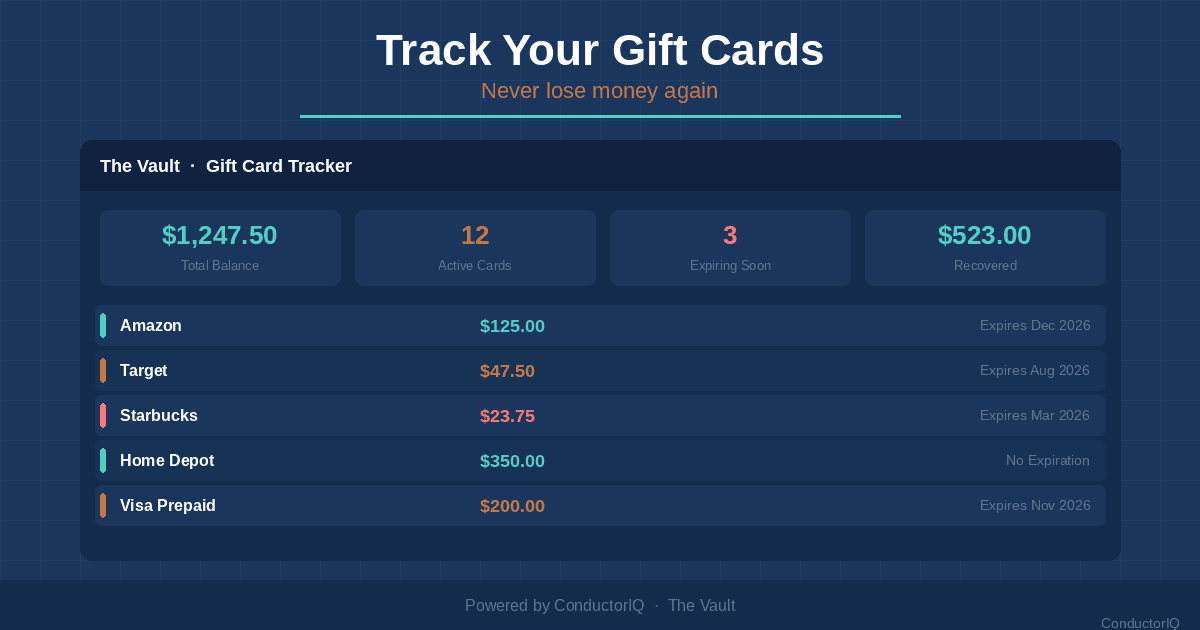
How it works: The Vault connects to your Gmail and automatically scans incoming email for gift card confirmations, store credit notifications, rebate approvals, and travel vouchers. When it finds one, it extracts the retailer, balance, redemption code, and expiration date, then stores the record with AES-256 encryption. You get staged SMS alerts at 30, 7, and 1 days before expiration. No manual data entry required for cards that arrived by email.
Strengths: Email scanning eliminates the manual-entry problem that kills most tracking systems. Cross-asset view means you see your total unused gift card balance and your upcoming warranty expirations and your unclaimed rebates in one dashboard. Encryption is AES-256 (the same standard banks use). Full data export is built in — if you ever leave, your data comes with you.
Limitations: ConductorIQ is a home management platform first. If you do not own a home, do not track any other assets, and just want a gift card list, you will use maybe 5% of what the app does. The email scanning works best with Gmail; other email providers are supported but with less automation. The average user recovers $1,200 per year in forgotten gift cards, credits, and vouchers — but that number assumes you have a meaningful number of assets to recover from in the first place.
For the broader context on what else The Vault surfaces, see 7 Types of Credits Hiding in Your Email.
HomeZada
Best for: Homeowners focused on home financial tracking (value, equity, insurance) who want a gift card list on the side.
HomeZada has been in the home management space since 2012 and approaches everything through a home-as-a-financial-asset lens. It tracks home value over time, monitors equity, organizes insurance policies, and maintains a home inventory. Gift cards are supported in the sense that you can add them as line items in the financial section.
Strengths: Strong financial tracking for the home itself. Good insurance policy management. Established product with multi-property support on the Deluxe plan.
Limitations: Gift card tracking is basic and manual. There is no email scanning, no automated capture, and expiration alerts are suggestion-based rather than proactive. If gift cards are a meaningful part of your "stuff I forget" problem, HomeZada will not solve it — you will be typing in cards one at a time, which is the failure mode that defeats every manual tracker. The full feature set requires the Premium ($99/year) or Deluxe ($189/year) plan.
Generic Budgeting Apps (Copilot, Monarch, YNAB, etc.)
Best for: Personal finance users who already use a budgeting app and want gift cards to appear alongside bank balances.
With Mint's shutdown in 2024, the budgeting app category reshuffled. Copilot, Monarch Money, Rocket Money, and YNAB absorbed most of the user base. None of them are gift card trackers by design. A few (particularly Copilot and Monarch) allow manual gift card entries as "assets" or "cash equivalents," which means you can see a gift card balance on your overall net worth dashboard.
Strengths: If you already live in a budgeting app, adding gift cards as manual assets keeps everything in one financial view. Useful for the "how much total spending power do I have" question.
Limitations: None of these apps are built for gift cards specifically. No email scanning for gift card emails (they scan for transactions, not confirmations). No expiration alerts. No redemption code storage — which means you still need another system to actually use the card at checkout. Budgeting apps are better at telling you that gift card balance exists than at helping you spend it before it disappears.
General Home Management Apps (Dib, HomeLedger)
Best for: Homeowners who want asset and warranty tracking but are willing to track gift cards in a separate app.
Most of the newer home management apps — Dib, HomeLedger, and others that emerged after the Centriq shutdown — focus on physical assets like appliances, HVAC systems, and vehicles. Financial tracking beyond warranties is typically out of scope.
Strengths: Strong asset and maintenance tracking. Useful companions to a dedicated gift card tool.
Limitations: Gift card tracking is either absent entirely or limited to generic "document storage" where you can upload a photo of a card. No email scanning. No expiration alerts. No encrypted PIN storage. If gift cards matter to you, these apps need to be paired with something else.
Comparison Table
Here is how the main apps compare across the features that actually determine whether a tracking system sticks. Pricing and feature availability change frequently in this category — verify current details on each app's site before signing up.
| App | Type | Gift Card Features | Cross-Asset Tracking | Email Scanning | Expiration Alerts | Price | Best For |
|---|---|---|---|---|---|---|---|
| ConductorIQ (The Vault) | All-in-one home platform | Full: balance, PIN (AES-256), partial balance, retailer logos | Yes (warranties, rebates, insurance, assets, vehicles) | Yes (Gmail auto-scan) | 30/7/1-day SMS + email | Free tier + Pro plan | Homeowners who want gift cards and everything else tracked |
| Slide (Raise) | Standalone marketplace + wallet | Buy/sell discounted cards; wallet for Slide purchases | No | No | Limited to Slide cards | Free (marketplace fees on sales) | People who want to liquidate or buy discounted cards |
| CardCash | Standalone resale | Sell cards for cash; trade for other cards | No | No | No | Free (resale spread) | Exit route for cards you will never redeem |
| Generic wallet apps | Standalone | Manual entry; basic list | No | No | Varies | Free–$5/mo | Tiny card lists, dedicated tracking only |
| Retailer apps (Starbucks, Target, etc.) | Brand-specific | Single-brand balance in real time | No | N/A (brand-only) | Inconsistent | Free | Brands you use weekly |
| HomeZada | All-in-one home platform | Manual entry in financial section | Yes (home value, insurance, inventory) | No | Suggestion-based | Free–$189/yr | Home-as-financial-asset users |
| Copilot / Monarch / YNAB | Budgeting | Manual entry as "asset" or cash equivalent | Partial (financial only) | Transaction scanning (not gift card confirmations) | No | $8–$15/mo | Users already in a budgeting app |
| Dib / HomeLedger | Home management | Minimal or none | Yes (assets, warranties, maintenance) | No | No (for gift cards) | Free–varies | Asset/warranty focus; pair with separate gift card tool |
Which App Is Right for You?
The right app depends on how gift cards fit into your overall "stuff I forget" problem. If gift cards are the only thing you lose track of, a standalone tool is fine. If gift cards are one symptom of a broader home management gap — warranties, rebates, insurance, maintenance records — an all-in-one platform saves you from juggling five apps. Here are the most common user profiles.
"I have three gift cards and just want them in one place."
A standalone wallet app or a retailer's native app (Starbucks, Target) is all you need. The friction of an all-in-one platform is not worth it for three cards.
"I have a dozen cards and I keep forgetting them."
This is the core market for Vault-style features. Manual-entry wallet apps will not solve this — you will stop adding cards after the first month. You need email scanning and staged expiration alerts. ConductorIQ's Vault is built for this profile.
"I want to liquidate cards I will never use."
CardCash or Slide are your tools. Use any tracking app to identify cards approaching expiration, then use a resale platform to recover 60-90% of the value.
"I own a home and gift cards are part of a bigger tracking problem."
This is where all-in-one platforms earn their keep. If you need to track warranties, rebates, insurance policies, maintenance, and a home asset inventory, a separate gift card app is a sixth tool you will forget to open. ConductorIQ is built for this profile. HomeZada works if financial-asset tracking is the priority. Our AI property management guide covers the broader AI-forward approach.
"I manage a rental or second property and want tenant/family access."
All-in-one platforms with multi-property and shared-access features (ConductorIQ, HomeZada, HomeLedger) handle this better than gift-card-specific tools. The same platform that handles your rental's warranties can also track the Home Depot credits you earned from renovations.
FAQ
Do gift card tracking apps actually work?
They work if you actually use them. The failure mode for every tracking app is manual data entry that nobody keeps up with. Apps that automate capture — either through email scanning or photo recognition — have far higher retention than apps that require you to type in every card. The average ConductorIQ Vault user recovers roughly $1,200 per year in gift cards, credits, and vouchers that would have otherwise expired or been forgotten.
Are standalone gift card apps safe?
It depends on the app. The minimum standard is AES-256 encryption for card numbers and PINs, the same encryption used by banks. Some smaller wallet apps store card data in plain text or use weaker encryption, which creates real risk — gift cards are bearer instruments, so anyone with the number and PIN can drain the balance. Before signing up, check the app's security documentation. If encryption practices are not published, assume the app is not safe to trust with PINs.
Can I track physical gift cards the same way as e-gift cards?
Yes, though the capture method differs. E-gift cards can be auto-captured from email confirmations by apps with scanning features. Physical cards typically require a photo or manual entry of the card number and PIN. Once added, both types track the same way — balance, expiration date, and alerts work identically. Some apps also let you scan the barcode on a physical card to populate the record faster than typing.
What happens when a gift card tracking app shuts down?
It depends on whether the app offers data export. When Centriq shut down in January 2025, users could download a spreadsheet of model numbers but had no bulk export for documents or photos, and all data was permanently deleted after the cutoff date. Before trusting an app with your gift card data, confirm that full export is supported and export at least once a year as a backup. Keep critical card numbers and PINs mirrored to a secondary location (encrypted cloud storage, password manager) so a shutdown does not wipe your records.
Is it worth paying for a gift card tracking app?
For most people, no — if the only thing you need tracked is gift cards, free tiers from ConductorIQ, Slide, or retailer-native apps cover the basic use case. Paying makes sense when you need cross-asset tracking (gift cards + warranties + rebates + documents in one platform), SMS expiration alerts rather than email-only, or multi-user access for a family or rental property. The ROI calculation is straightforward: if the app helps you recover even one forgotten $50 card per year, it has paid for itself.
The Bigger Picture: Gift Cards Are One Leak Among Many
The interesting finding from the $23 billion gift card data is not just the total dollars lost. It is that the same homeowners losing money on gift cards are also losing money on expired warranties, unclaimed rebates, and lapsed insurance policies. Gift cards are the visible tip of a larger tracking problem.
The question is not "which gift card app is best?" It is "what else am I already forgetting?" If the honest answer is "just gift cards," a standalone app is fine. If the answer is "gift cards plus half the paperwork in my home," you are the reason all-in-one platforms exist.
Whichever app you pick, automate the capture. Manual entry is the reason most tracking systems fail, and no amount of willpower will change that.
Start your free ConductorIQ account and see what The Vault finds in your email.
Related Reading
- The $23 Billion Problem: Why Americans Forget Their Gift Cards
- How to Track Gift Cards So You Never Lose Money Again
- 7 Types of Credits Hiding in Your Email Right Now
- Best Centriq Alternatives in 2026 (After the Shutdown)
- Home Asset Inventory: Why Every Homeowner Needs One
- AI in Property Management: What Actually Works in 2026
{
  "@context": "https://schema.org",
  "@graph": [
    {
      "@type": "BlogPosting",
      "headline": "Best Gift Card Tracking Apps 2026: Standalone vs. All-in-One Compared",
      "description": "Compare the best gift card tracking apps in 2026. Standalone wallets vs. all-in-one home platforms — which actually stops the $23B gift card leak?",
      "author": {
        "@type": "Organization",
        "name": "ConductorIQ Team",
        "url": "https://conductoriq.com"
      },
      "publisher": {
        "@type": "Organization",
        "name": "ConductorIQ",
        "url": "https://conductoriq.com",
        "logo": {
          "@type": "ImageObject",
          "url": "https://conductoriq.com/logo.png"
        }
      },
      "datePublished": "2026-04-30",
      "dateModified": "2026-04-30",
      "mainEntityOfPage": {
        "@type": "WebPage",
        "@id": "https://blog.conductoriq.com/16-gift-card-apps-compared"
      },
      "image": "https://blog.conductoriq.com/images/blog/gift-card-apps-compared.png",
      "keywords": "gift card tracking app, best gift card tracker, gift card organizer app, track gift cards balance, gift card wallet, gift card manager",
      "articleSection": "The Vault — Financial Recovery",
      "wordCount": 2750,
      "about": [
        {
          "@type": "SoftwareApplication",
          "name": "ConductorIQ",
          "applicationCategory": "Home Management",
          "url": "https://conductoriq.com"
        },
        {
          "@type": "SoftwareApplication",
          "name": "Slide",
          "applicationCategory": "Gift Card Marketplace"
        },
        {
          "@type": "SoftwareApplication",
          "name": "CardCash",
          "applicationCategory": "Gift Card Resale"
        },
        {
          "@type": "SoftwareApplication",
          "name": "HomeZada",
          "applicationCategory": "Home Management"
        }
      ]
    },
    {
      "@type": "FAQPage",
      "mainEntity": [
        {
          "@type": "Question",
          "name": "Do gift card tracking apps actually work?",
          "acceptedAnswer": {
            "@type": "Answer",
            "text": "They work if you actually use them. The failure mode for every tracking app is manual data entry that nobody keeps up with. Apps that automate capture — either through email scanning or photo recognition — have far higher retention than apps that require you to type in every card. The average ConductorIQ Vault user recovers roughly $1,200 per year in gift cards, credits, and vouchers that would have otherwise expired or been forgotten."
          }
        },
        {
          "@type": "Question",
          "name": "Are standalone gift card apps safe?",
          "acceptedAnswer": {
            "@type": "Answer",
            "text": "It depends on the app. The minimum standard is AES-256 encryption for card numbers and PINs, the same encryption used by banks. Some smaller wallet apps store card data in plain text or use weaker encryption, which creates real risk — gift cards are bearer instruments, so anyone with the number and PIN can drain the balance. Before signing up, check the app's security documentation."
          }
        },
        {
          "@type": "Question",
          "name": "Can I track physical gift cards the same way as e-gift cards?",
          "acceptedAnswer": {
            "@type": "Answer",
            "text": "Yes, though the capture method differs. E-gift cards can be auto-captured from email confirmations by apps with scanning features. Physical cards typically require a photo or manual entry of the card number and PIN. Once added, both types track the same way — balance, expiration date, and alerts work identically. Some apps also let you scan the barcode on a physical card to populate the record faster than typing."
          }
        },
        {
          "@type": "Question",
          "name": "What happens when a gift card tracking app shuts down?",
          "acceptedAnswer": {
            "@type": "Answer",
            "text": "It depends on whether the app offers data export. When Centriq shut down in January 2025, users could download a spreadsheet of model numbers but had no bulk export for documents or photos, and all data was permanently deleted after the cutoff date. Before trusting an app with your gift card data, confirm that full export is supported and export at least once a year as a backup."
          }
        },
        {
          "@type": "Question",
          "name": "Is it worth paying for a gift card tracking app?",
          "acceptedAnswer": {
            "@type": "Answer",
            "text": "For most people, no — if the only thing you need tracked is gift cards, free tiers from ConductorIQ, Slide, or retailer-native apps cover the basic use case. Paying makes sense when you need cross-asset tracking (gift cards plus warranties plus rebates plus documents in one platform), SMS expiration alerts rather than email-only, or multi-user access for a family or rental property."
          }
        }
      ]
    }
  ]
}